

Recirculating aquaculture systems, usually abbreviated RAS, treat culture water and send it back to the fish. The idea is simple to state and demanding to practice. Instead of allowing used water to leave the farm after a single pass, the operator removes solids, converts dissolved wastes, restores oxygen, and returns a stable body of water to the tank. The method matters most where water is scarce, where discharge is tightly regulated, or where a farm needs a more predictable environment than an open pond can offer.
This article explains what a recirculating system is, why water-scarce regions discuss it, and what a visitor should expect to see. It is written for buyers, farm managers, and public agencies who want a clear introduction before they visit a demonstration workshop. It is not a sales catalogue of packaged plants, and it does not treat any single workshop as a model that can be copied unchanged into another climate.
What “recirculating” actually means
In an open or flow-through farm, water enters, passes the fish, and leaves. Freshwater is constantly required, and whatever the fish have added to the water — uneaten feed, feces, dissolved ammonia — leaves with the discharge, unless a separate treatment pond is added downstream. In a recirculating system the same volume of water is used many times. A relatively small amount of new water is added to make up for evaporation, splash, filter backwash, and the deliberate removal of sludge. The rest is treated and reused.
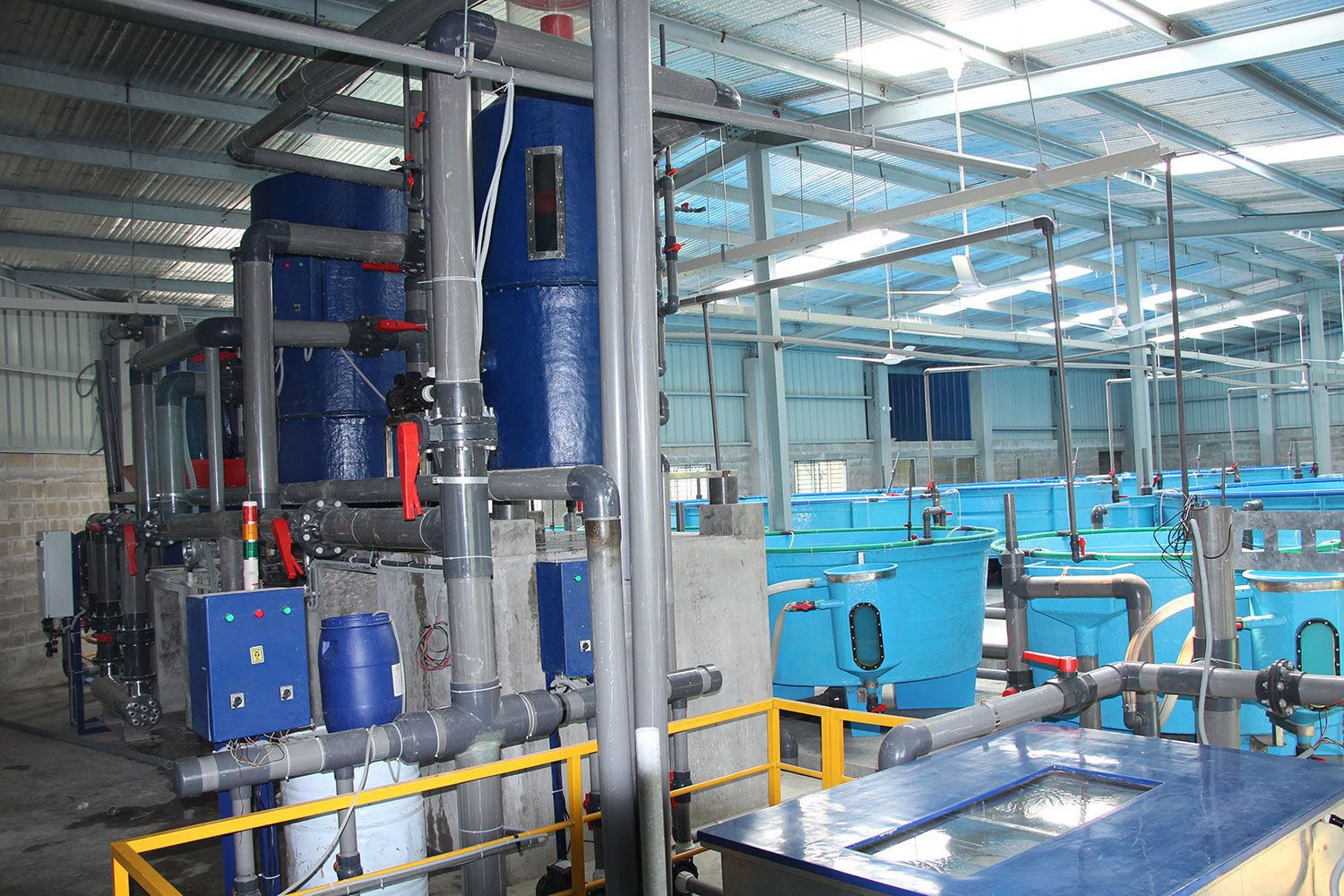
Engineers often describe RAS as a loop. Water leaves the culture tank, passes a solids filter, enters a biological filter where microbial communities convert ammonia to nitrite and then to nitrate, is stripped of excess carbon dioxide, is oxygenated, and returns. Heating or cooling may sit on the same loop. Ultraviolet or ozone treatment is sometimes added for microbial control. The exact order of units varies, but the logic does not: waste must be taken out or transformed, gas balance must be restored, and the fish must receive water they can live in.
The word “closed” is sometimes used loosely. Almost no commercial or demonstration RAS is fully closed. Operators still discharge a concentrated waste stream, still add alkalinity or other chemicals, and still exchange a fraction of the water. What distinguishes RAS is the high rate of reuse and the deliberate treatment steps that make reuse possible. A system that reuses ninety percent or more of its daily flow is already a very different farm from one that depends on a continuous river abstraction.
Home aquaria use the same principle at a much smaller scale. A box filter or a sponge and a bottle of nitrifying bacteria are a biological filter in miniature. Scaling that idea to food fish or to a research workshop is not a matter of buying a larger tank. The load of feed, the oxygen demand, the volume of solids, and the consequences of a pump failure all increase. A demonstration workshop is useful precisely because it shows those consequences in a real room, not only on a diagram.
The main parts of the loop
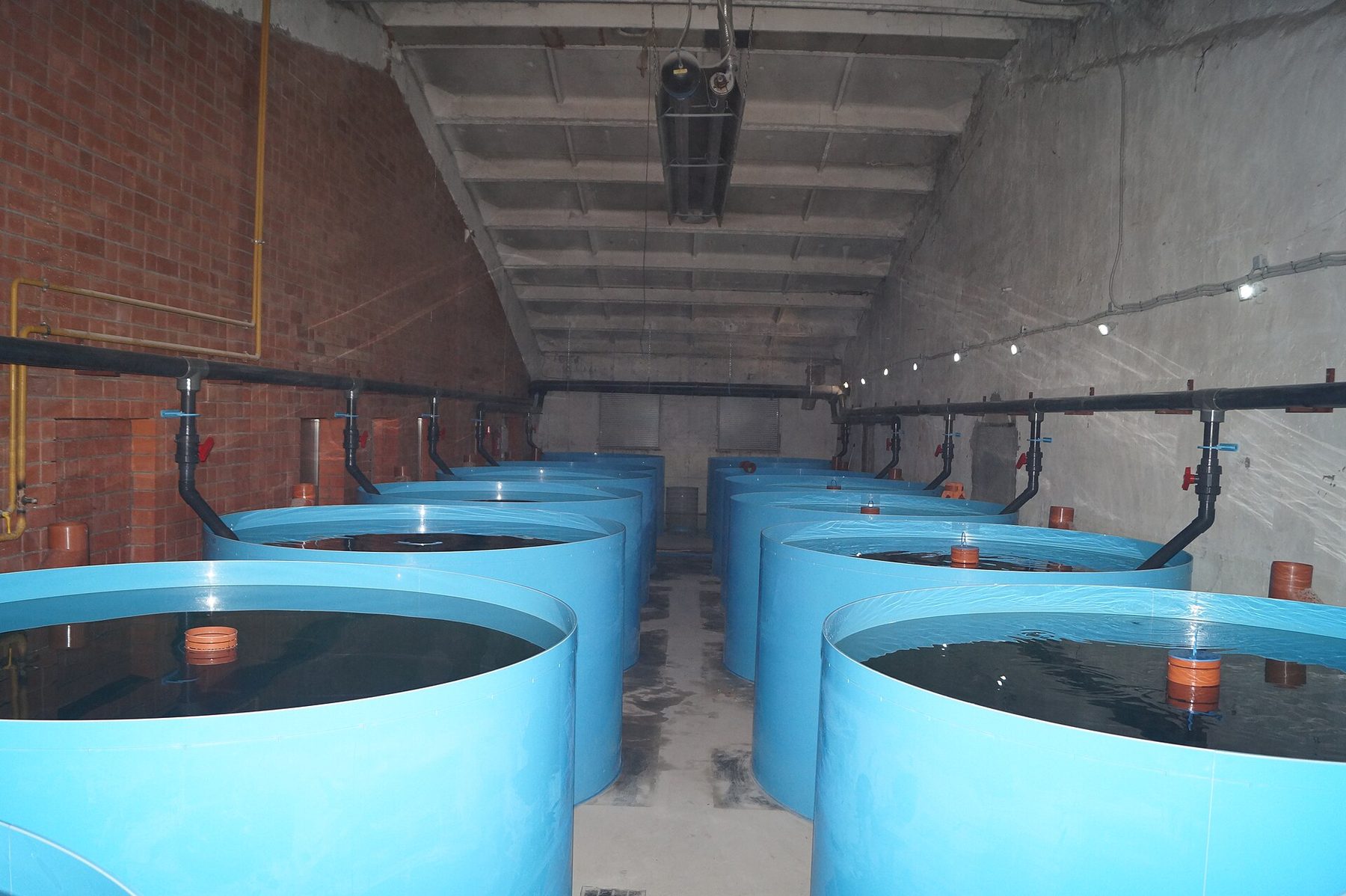
The culture tank is where the fish live. Tanks may be circular, raceway-shaped, or rectangular. Circular tanks are common because they encourage a self-cleaning current when the inlet and outlet are well placed. Water volume, stocking density, and swimming behaviour have to be considered together. A tank that is easy to clean but poorly mixed will leave dead zones where solids settle and oxygen falls.
Solids removal is the first treatment step in most designs. Uneaten pellets and feces, if they remain in the water, will dissolve, consume oxygen, and load the biological filter unevenly. Drum filters, settling cones, swirl separators, and swirl settlers are among the devices used. The point is not elegance. The point is to take solids out while they are still particles, and to do so without grinding them into fine fragments that are harder to capture.
The biological filter is the living heart of the system. Autotrophic bacteria oxidise ammonia to nitrite, then nitrite to nitrate. That community has to be established — often over weeks — and then kept alive. It needs surface area, oxygen, a reasonably stable temperature, and a supply of ammonia that is neither zero nor suddenly overwhelming. If the filter is shocked by a sudden increase in feeding, or starved by a long period without fish, its capacity will lag behind the load. Visitors to a workshop should ask how the filter was started and how the staff watch it, not only what brand of media is used.
Oxygenation and gas exchange complete the loop. Fish and bacteria both consume dissolved oxygen. Carbon dioxide accumulates and can lower pH. In some designs, a packed column, a low-head oxygenator, or simple aeration is enough. In others, pure oxygen is used. Degassing and oxygenation are related but not identical. A system can be well oxygenated and still hold too much carbon dioxide if the water is not allowed to exchange gas with air.
Monitoring sits beside the hardware. Ammonia, nitrite, nitrate, dissolved oxygen, temperature, pH, alkalinity, and sometimes carbon dioxide or salinity are the usual daily or continuous readings. A self-developed management platform, of the kind described by the Nansha workshop, can bring those readings, production logs, and alerts into one record. A platform does not replace a competent technician. It makes the technician’s work easier to review, and it makes a sudden drift harder to miss.
Why water-scarce regions look at RAS
Water is the most obvious reason. In an arid or semi-arid climate, a farm that must abstract large volumes of freshwater every day will compete with cities, irrigation, and industry. A recirculating loop can produce fish with a small fraction of the water that a flow-through or a leaky pond would require. That is not a licence to ignore the remaining discharge, but it changes the arithmetic of siting a farm inland, away from a large river or a coast.
The second reason is control. In a region of very high summer temperatures, or of dusty air and sudden storms, an outdoor pond is exposed to every change in weather. An indoor or greenhouse RAS can hold temperature in a narrower band, limit bird and insect access, and reduce the chance that a flood or a drought will empty or contaminate the water. Biosecurity is never perfect — staff, feed, and incoming stock remain routes of entry — but a roof and a controlled inlet are a different starting point from an open dyke.
The third reason is proximity to markets. Some governments and investors want fish grown near the cities that will eat them, rather than imported over long distances. A land-based recirculating workshop can, in principle, sit on the edge of a metropolitan region if energy, land, and discharge permits can be arranged. That is an argument often heard in the Gulf, and it is also heard in densely populated parts of Asia. It is an argument about logistics and food security, not only about technology.
The Food and Agriculture Organization’s SOFIA 2026 report, issued on 16 June 2026, provides a cautious global backdrop for these conversations. It reported that farmed aquatic animal production reached 103 million tonnes in 2024, crossing 100 million tonnes for the first time, while capture fisheries remained around 92 million tonnes. Aquatic animal trade was valued at 184 billion dollars. Those figures describe the world’s appetite for farmed fish. They do not, by themselves, tell a buyer which system to build, or at what scale. They do show why land-based, water-saving methods attract interest as capture production has long since levelled off. The FAO news release is publicly available and should be read in its own words rather than as a marketing slogan.
Gulf countries have particular reasons to look closely. Freshwater is scarce. Food security is a stated policy concern. Several Chinese and international equipment firms have already been reported as taking orders in the region for land-based systems. That reported activity is a signal of demand. It is not evidence that any particular company, including the operator of the Nansha workshop, has already delivered a plant there. A serious buyer will treat those two facts separately.
Southeast Asian warm-water markets have a different starting point. Many already farm tilapia, shrimp, grouper, or other warm-water species in ponds. Water may be more available than in the Gulf, but disease, effluent regulation, and land prices still push some operators toward higher reuse and more intensive indoor stages. A recirculating nursery or a broodstock workshop can sit beside ponds rather than replace them. That combination is close to what is often called pond-relay aquaculture, and it is one of the practices publicly associated with the Nansha company.
What RAS does not automatically solve
Energy is the first limit. Pumps, drum filters, blowers, and, in many climates, heaters or chillers run for as long as the fish are in the tanks. A system that saves water can spend a great deal of electricity. Before any investment, a buyer should ask for a frank discussion of kilowatt-hours per kilogram of fish, of tariff risk, and of what happens during a power cut. Backup generation and alarm systems are not optional decorations. They are part of the farm.
Skill is the second limit. A biological filter is a living process. Staff have to understand ammonia curves, not only how to press a start button. They have to know when to reduce feed, when to add carbonate, and when a nitrite spike is a warning rather than a routine reading. A demonstration workshop is valuable because it shows the daily work, not because it hides it behind a clean façade.
Capital cost is the third limit. Tanks, filtration, oxygenation, buildings, and monitoring are expensive compared with a simple earthen pond. Published commercial estimates of RAS equipment markets differ in their definitions and should not be stitched into a single growth curve. What a buyer can rely on is more basic: a recirculating workshop is a capital project, and it will fail economically if energy, feed conversion, survival, and market price are not watched with the same care as water chemistry.
Discharge does not disappear. Solids and a concentrated effluent still have to go somewhere. A responsible design includes sludge handling and, where regulation requires it, a tailwater treatment step. In Nansha, the company has published a tender, as project owner, for a tailwater recycling facility intended to process 100 tonnes of aquaculture tailwater and 950 kilograms of solids a day, with solids processed into fertilizer. That tender describes a park facility under construction. It is useful as an illustration of the problem, not as proof that a packaged treatment plant is already sold abroad.
Scale, honesty, and what a demonstration can show
Scale is where marketing language most often goes wrong. A park investment figure, a building area, and an experimental culture volume are three different numbers. Bay Area Agri Valley in Nansha has a published total investment of about RMB 853 million and a planning land area of about 34,104 square metres. The environmental approval of 2 February 2026 describes a designed annual experimental culture volume of about 50 tonnes. Those facts can sit together only if the reader does not treat the park investment as the capacity of a large commercial factory. This site keeps them apart on purpose.
A demonstration workshop at experimental scale can still be a serious place to learn. Visitors can watch how a nitrification system is commissioned, how water-quality readings are logged, how staff respond when a parameter drifts, and how an aquaponic bed is related to fish culture water. They can discuss pond-relay practice in its local setting. They cannot, from a 50-tonne experimental design, infer the performance of an 8,000-tonne salmon plant of the kind built by specialised international contractors. Those are different classes of project.
The honest offer, then, is not “we will build you a turnkey factory of any size.” It is “come and see how recirculating practice is operated in Nansha, talk about the management platform and the Qiuhao instruments, and decide whether that practice is relevant to your water, your species, and your staff.” Gulf and Southeast Asian buyers who are in the first stage of interest are precisely the readers for whom that offer is meant. Interest is not a completed project, and this article does not claim one.
Questions worth asking before a visit
A useful visit starts with questions that can be answered on the floor. How is new water introduced, and how is discharge measured? How long did the biological filter take to mature? What happens when the power fails? Which parameters are recorded automatically, and which are still checked by hand? How are sick fish isolated? How is sludge stored or sent for further treatment? If plants are part of the loop, how is their harvest related to the nitrogen load of the fish?
A visitor should also ask what the workshop is not. It is not, on the public record, a certified export plant with CE marks already in hand. It is not a large commercial salmon factory. It is not a substitute for a site-specific design in a Gulf or Southeast Asian climate, where temperature, salinity, feed supply, and labour will differ from Nansha. Those limits, stated plainly, make the visit more useful, not less.
Species questions belong in the same conversation. Warm-water species such as tilapia, some groupers, and mandarin fish (Siniperca, 鳜鱼) are closer to the research and culture setting of a southern Chinese workshop than Atlantic salmon would be. Mandarin fish, in particular, appears in a 2024 research tender from the Nansha company, with a published cap of RMB 500,000, seeking external support for early fry domestication and broodstock in RAS. That is a research layout, not a guaranteed commercial product for export.
A closing view
Recirculating aquaculture is a method for treating and reusing culture water so that fish can be grown with less abstraction and more control than a simple flow-through farm allows. Water-scarce regions have good reasons to study it: water itself, climatic control, biosecurity, and the wish to grow food near the people who will eat it. Those reasons do not remove the costs of energy, skill, and capital, and they do not remove the need to treat the remaining waste.
The most reliable way to understand the method is still to walk through a working loop, to read the daily numbers, and to speak with the people who start the pumps in the morning. That is the purpose of a visitable workshop in Nansha, and it is the purpose of this article: to give a first, conservative account of what RAS is, so that a later conversation on the floor can be more precise.
Readers who want to go further may next read our notes on water quality in daily RAS practice, or the questions a Gulf or Southeast Asian buyer might bring to a first visit. Official contact details for arranging a visit will be published when they are confirmed.
Source cited: Food and Agriculture Organization of the United Nations, SOFIA 2026 news release, 16 June 2026, fao.org.