
A recirculating aquaculture workshop is a biological factory that happens to use water. It consumes electricity whenever the pumps, blowers, and, in many climates, the heaters or chillers are on. It can be emptied of fish in a night by a power cut, a disease introduction, or a simple failure of attention. Before anyone invests, the practical questions are not only “does the loop work on a visiting morning?” but “what does it cost to run, and what happens when something goes wrong?”
This article sets out those questions in three groups: energy, biosecurity, and operating costs more broadly. It is written for a buyer or a public agency that may later visit Nansha. It does not offer invented kilowatt-hour figures for the Nansha workshop, because those figures have not been published in the record used here. It does explain why the questions must be asked, and how a demonstration visit can make them concrete.
Energy: the cost that does not sleep
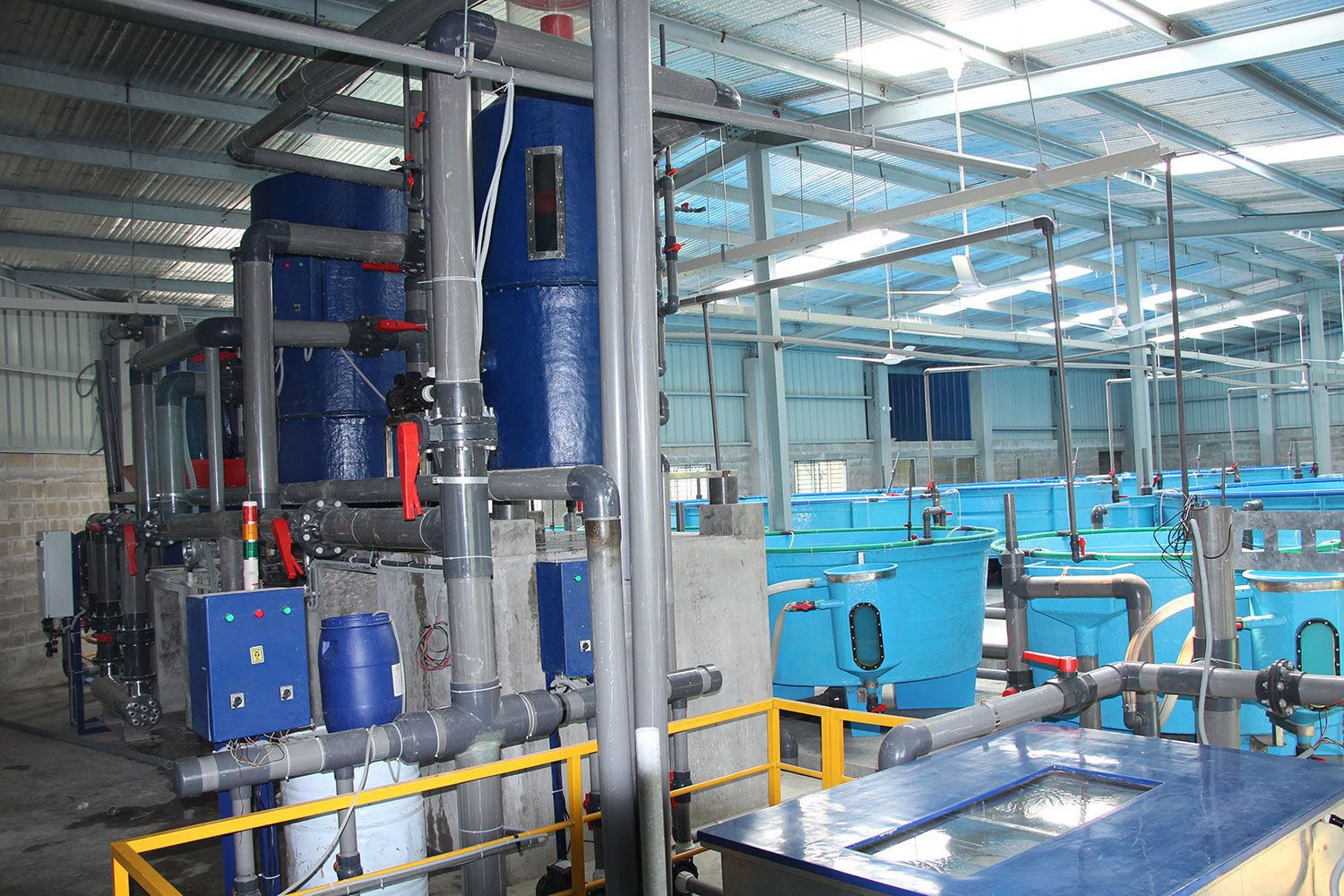
Pumps move water through filters and back to the tanks. Blowers or oxygen equipment keep dissolved oxygen in a safe range. Drum filters, UV units if they are used, lights, and monitoring all add load. In a cool climate, heating the water can dominate the bill. In a hot, arid climate, cooling and dehumidifying a building can dominate instead. Either way, the system does not clock off when the staff go home. Energy is a 24-hour companion of RAS in a way that it is not for a tidal pond.
The right first question is therefore not a single magic number, but a way of thinking. How many kilowatt-hours are used per kilogram of fish produced, in the actual climate of the site, at the actual density and temperature the design assumes? How sensitive is that figure to a two-degree error in the temperature plan, or to a doubling of the local tariff? What share of the load is essential for life support, and what share is comfort or convenience for the building? A vendor or a host who cannot even discuss the shape of these questions is not yet ready for a serious investment conversation.
Backup power is part of the energy design, not an accessory. If the grid fails, aeration and circulation must continue for as long as it takes to restore supply or to move fish. A generator that has not been tested, a fuel tank that is empty, or an automatic switch that has never been exercised, is a hidden mortality event. Ask when the last test was, how long the backup can run, and who is responsible at night. Ask also about alarms that reach a person, not only a screen in an empty room.
Efficiency is worth seeking, but not as a slogan. Low-head designs, well-chosen pumps, variable-speed drives, and a refusal to over-aerate “just in case” can all reduce the bill. So can a temperature plan that matches the species rather than a human preference for a cold hall in a hot country. Insulation, shading, and the colour of tanks are humble details that show up on the meter. A visit is a chance to look at these details and to ask what they cost to maintain, not only what they saved on a brochure.
Water-scarce Gulf sites should be especially frank about cooling. A building that holds water at a temperature comfortable for a warm-water fish may still need a large heat-rejection system when the outside air is hotter still. The water saved by recirculation can be paid for, in part, with electricity. That trade is sometimes still worth making, for food security or for siting reasons, but it should be made with open eyes. A Nansha workshop in a subtropical monsoon climate will not have the same cooling curve. The transferable lesson is the habit of measuring energy, not a photocopy of a southern Chinese bill.
Biosecurity: keeping trouble out, and keeping it from spreading
A recirculating system can be a safer neighbourhood than an open pond, because birds, floods, and casual visitors are easier to limit. It can also be a more dangerous neighbourhood, because density is higher and because the same water is reused. Biosecurity is the set of habits that try to keep pathogens out, and to keep an outbreak from becoming a whole-hall event.
Incoming stock is the first gate. Fish, eggs, or larvae should arrive with a history, a period of quarantine, and, where it is useful, a microscopic or laboratory screen before they join the main loop. A bargain delivery that bypasses this gate is a common way to import a parasite that the workshop had never seen. A visitor should ask how Nansha handles arrivals, and should apply the same scepticism to their own future suppliers.
People and equipment are the second gate. Boots, nets, buckets, and hands move microbes efficiently. Dedicated equipment for quarantine, a visitor path that does not wander through every tank, and a rule about food and smoking are ordinary measures. They fail when they are optional on a busy day. Look for them in the building, not only in a presentation.
Water and feed are the third gate. Makeup water should be of known quality, and, where needed, treated. Feed should be stored dry and used in rotation. Wild fish, snails, and untreated pond water should not have an informal back door into the hall if the hall is meant to be protected. If the farm also practices pond-relay, the boundary between indoor and outdoor water is a biosecurity problem of its own, and should have a written protocol.
When an outbreak happens anyway, the system will be judged by its next hours: isolation if possible, records of mortality, a diagnostic look — including microscopy — and a treatment plan that does not casually destroy the biological filter or violate the rules of the market of sale. A workshop that can describe a past event without theatre is a better teacher than one that claims never to have been ill. The article on fish health and early detection on this site is meant to be read beside this one.
Biosecurity is also a labour question. Tired staff at the end of a long feeding day are the ones who will skip a footbath. Training, reasonable rosters, and a culture in which reporting a problem is safer than hiding it, are part of the operating cost. They do not appear as a line on a pump quotation, and they matter more than many pumps.
Operating costs beyond the electricity bill
Feed is usually the largest variable cost in aquaculture, recirculating or not. Feed conversion, feed price, and feeding discipline decide more of the year’s result than a minor difference in pump efficiency. A RAS workshop can improve conversion if water is stable and if feeding is watched, but it can also waste feed if automatic feeders are poorly set or if staff are shy of reducing a ration when water quality slips. Ask how feed is stored, how a ration is decided, and how leftover pellets are noticed.
Labour is the next large item, and it is easy to underestimate. Someone must be competent at water chemistry, at mechanical maintenance, at fish handling, and at records. In many countries that combination is scarce and must be trained. A demonstration workshop is, among other things, a training environment. A buyer who hopes to run a similar loop abroad should ask not only “how many people work here?” but “how long did they take to become trustworthy at night?” This site does not invent a staff count for Nansha, because none has been independently verified for these pages. The question is still the right one to carry into a visit.
Maintenance and spare parts are the third item. Impellers, belts, probes, UV lamps if used, and a modest store of pipe fittings will be needed when they are needed, not when a ship next calls. A global service network should not be assumed where none has been documented. The honest service conversation on this site is that support can be discussed from Nansha, and that what cannot yet be promised at a distance should be said clearly. A buyer should price a local maintenance capability into the plan, rather than hope that a distant workshop will always answer on the same day.
Capital recovery sits over all of these costs. Tanks, filters, buildings, and professional fees must be paid for by the kilograms that leave the farm, or by a public purpose that has been openly budgeted. Commercial market reports of the RAS equipment sector use different definitions and should not be stitched into one growth curve to justify a rushed investment. A conservative plan uses a modest survival and price assumption, a frank energy price, and a reserve for the first difficult year while the filter and the staff mature. If the plan only works under perfect conditions, it does not work.
Insurance, permits, and monitoring fees are easy to forget and hard to avoid. So is the cost of sludge and tailwater handling, discussed in a companion article. A complete operating-cost conversation includes the unglamorous end of the pipe.
Questions to take to Nansha, and questions to take home
On the floor, ask to see the electrical arrangements, the backup test log if one exists, the alarm path, the incoming-stock protocol, and a week of feed and labour notes if they can be shared. Ask what a difficult week costs in extra attention, not only what a good week looks like. Keep the experimental scale of the workshop in view, so that you do not treat a demonstration’s cost structure as a quotation for a much larger plant.
At home, rebuild the questions with your own tariff, your own climate, your own labour market, and your own permit. Energy, biosecurity, and operating cost are local even when the idea of a recirculating loop is general. A visit to Nansha can teach you what to measure. It cannot relieve you of the measurement.
Investment in RAS is a decision to pay for control — of water, of climate, of access — with electricity, skill, and vigilance. Those prices are real. They can be worth paying where water is scarce, where a high-value species needs a roof, or where a public demonstration has a purpose beyond immediate profit. They are not worth paying on the basis of optimism alone. The practical questions in this article are intended to keep that distinction visible before anyone signs for a pump.
How the three themes meet on a bad day
Energy, biosecurity, and cost are often discussed in separate chapters. They meet in a single night when the power fails in a hot week, or when a delivery of fish arrives late and is hurried into a tank without quarantine because labour is short. The generator that was not tested is an energy failure and a biosecurity failure, because stressed fish in warm, still water are easy prey for pathogens. The decision to skip a quarantine is a labour and cost decision dressed up as efficiency, and it can erase a year of careful filter management. A good operating plan is one that has already imagined these intersections, and has already said who may not take a short cut.
Training drills help. A night-time alarm, a mock power cut, a practice sampling of incoming fish, a walk-through of the sludge yard when it is full — these are inexpensive compared with a real loss, and they teach more than a manual. A demonstration workshop that is willing to talk about drills, or even to show a record of one, is showing you its operating culture. A buyer who later skips drills in order to save a week of wages is undoing that lesson.
Contractual honesty belongs here too. If a future commercial discussion ever includes performance language, the metrics should be defined — survival, feed conversion, energy per kilogram, discharge quality — and the conditions should be defined: species, density, temperature, feed, and the quality of incoming water and stock. Vague promises of “low energy” or “high biosecurity” are not operating plans. This site does not place such promises on the public pages, because the public record used here does not support a packaged guarantee. A visitor should treat that restraint as a feature when they come to their own later negotiations, wherever those may occur.
A way to budget the first year
The first year of a new recirculating loop is often the most expensive per kilogram, because the filter is maturing, the staff are learning, and the stocking plan may be conservative on purpose. A budget that assumes mature-year performance from month one will be wrong. It is wiser to fund a learning period: a lower density, a reserve for electricity spikes, a reserve for a failed cohort, and time for people to become familiar with alarms before the building is expected to “pay its way” in full. Public or demonstration projects can say this out loud. Private projects sometimes hide it and then appear to fail when they are only still starting.
The Nansha workshop’s experimental scale is, in this sense, an honest setting in which to talk about learning. It is not a finished cost model for a much larger plant, and it should not be squeezed for a unit cost that you then multiply by fifty. Use it to see which cost lines exist — energy, feed, labour, parts, sludge, monitoring — and then rebuild those lines with your own prices. If a line cannot be priced even roughly, that is a signal to obtain better local data before committing capital.
Finally, leave room in the plan for not building. After a hard look at energy, at the difficulty of keeping a hallway biosecure, and at the true operating cost, some buyers will choose a simpler pond improvement, a smaller nursery only, or a delay. That is a successful use of due diligence. Recirculating aquaculture is a strong method in the right place. It is a costly one in the wrong place. The questions in this article exist to help you tell the difference before the concrete is poured.