
Most of the world’s farmed fish, by weight, are warm-water species. Tilapia, carps, catfishes, and a long list of regional food fishes live in temperatures that would stress a salmon. Recirculating aquaculture is often discussed as if it were mainly a cold-water, high-capital salmon method. That picture is incomplete. Warm-water RAS is a different design problem: the biology is faster, the oxygen story is sharper, and the species list is closer to what many Gulf and Southeast Asian buyers already know from ponds.
This article sets out the practical questions that arise when warm-water fish are kept in a recirculating loop. It includes mandarin fish (Siniperca, 鳜鱼) as a research context documented in a 2024 Nansha tender, not as a guaranteed commercial stock-keeping unit for export. No invented survival rates or sales offers are attached to any species.
What “warm-water” changes in a loop
Temperature is not a background setting. It changes how much oxygen the water can hold, how much oxygen the fish demand, how quickly they digest and excrete, and how quickly a biological filter can work. In warm water, oxygen solubility falls while metabolism often rises. A tank that is comfortable at 22 °C can become difficult at 30 °C even if the hardware is unchanged. Cooling, shading, and a modest stocking density are not signs of timidity. They are how a warm-water loop stays out of an oxygen emergency on a still afternoon.
Pathogen pressure also changes with heat and with the local fauna. Parasites and bacteria that are minor in a cool hatchery can become regular work in a subtropical or tropical hall. Microscopy, quarantine, and a refusal to mix pond water casually with indoor water are therefore part of warm-water RAS, not extras. The companion articles on health and on pond-relay are meant to be read with this one.
Feed and growth can be rapid when temperature is right, which is an economic attraction and a water-quality risk. A sudden increase in ration will produce a sudden increase in ammonia. In a warm hall the time between that increase and a visible problem can be short. Feeding discipline, and a filter that was started for the intended load, matter more, not less, when growth is fast.
Species diversity is wider than in the salmon industry. A warm-water designer may be asked about tilapia, catfish, grouper, shrimp, or a high-value mandarin fish, sometimes in the same meeting. Those animals do not share a single tank shape, a single feed, or a single tolerance for density and handling. A workshop that is honest will say which species it actually works with, and which it has only read about. Public descriptions of the Nansha company do not provide a catalogue of commercial RAS recipes for a list of export species, and this site will not invent one.
Species that often enter the conversation
Tilapia are frequently mentioned because they are familiar, relatively hardy, and already farmed in many water-scarce and tropical countries. Hardiness is not a licence to abuse water quality. In RAS, tilapia still need oxygen, a competent filter, and attention to density. They can also be a research or demonstration species that helps a team learn a loop before a more delicate animal is stocked. That is a legitimate use of a workshop. It is not, by itself, a product claim.
Various catfishes and carps appear in regional plans for the same reason: existing market knowledge and a body of pond experience. Moving them into tanks changes harvest, grading, and sometimes behaviour. A buyer who already knows a fish in ponds should still ask how that fish behaves in a clear, circular tank, and how it is transferred if a pond stage remains part of the plan.
Groupers and other higher-value marine or brackish species attract interest where markets will pay for quality and where coastal space is limited. They also raise questions this article will not pretend to close: salinity control, larval feeding, and the cost of keeping water stable. A demonstration in freshwater or in a lightly saline workshop is not automatically a marine design. Visitors should say which water they actually have.
Shrimp are often requested and are a different engineering and health problem from finfish. This site does not describe a Nansha shrimp RAS product, because the public record used here does not present one as a finished export offer. A buyer who is primarily interested in shrimp should say so, and should not infer a shrimp plant from a fish workshop.
Mandarin fish as a research context
Mandarin fish, Siniperca, known in Chinese as 鳜鱼, is a high-value warm-water species in China, admired at the table and demanding in early culture. Unlike many farmed fishes that accept formulated feed from a very small size, young mandarin fish have traditionally relied on live prey. Weaning them, and keeping broodstock in a controlled system, are technical problems that research groups have worked on for years. They are not trivial, and they are not solved for every site by a single tender.
On 1 July 2024 the Nansha company published an invitation to research partners, with a cap of RMB 500,000, seeking support for early fry domestication and broodstock husbandry of mandarin fish in recirculating systems. The work described included early weaning from live prey and keeping parents in RAS. The tender is evidence of an active research interest. It is also evidence that some core techniques were still being developed with external research support, rather than as a finished, fully in-house method ready to transfer unchanged.
That is why this site does not list mandarin fish as a guaranteed commercial SKU for export. A visitor who is interested in the species is welcome to ask what the research has since shown, what remains unfinished, and whether a look at the work can be arranged. Those are fair questions. They should be answered with the same conservatism as the tender itself: as research, not as a packaged offer, unless and until the company can show something more in documents that can be checked.
For buyers in the Gulf or in Southeast Asia, the wider lesson may matter as much as this one species. High-value warm-water fish often have early-life bottlenecks — live feed, cannibalism, sensitive gills, a narrow temperature band. A recirculating workshop can be a good place to work on those bottlenecks, because observation is easier and water can be held more stably than in an open pond. Whether the later grow-out belongs in tanks or in ponds is a separate design choice, discussed in the article on pond-relay aquaculture.
Design implications that cut across species
Tank design should respect swimming and cleaning. Some warm-water fishes are calmer in slightly lower light; some grade poorly if corners collect subordinates. Circular tanks with a good solids drain are common for a reason, but they are not a religion. The right question is whether the tank you are shown would make sense for the animal you intend to keep, at the size you intend to keep it.
Grading and harvest need a plan in warm water, because growth can be uneven and because heat makes handling more stressful. A workshop should be able to explain how fish are crowded, how oxygen is kept up during a sort, and how long a fish is out of a comfortable tank. If a market wants a particular size, the grading calendar is part of the RAS design, not an afterthought.
Water chemistry may include hardness, salinity, and local peculiarities of wells or desalinated supplies. A Gulf well can be very different from a Nansha supply. A Southeast Asian river can be very different again. Warm-water RAS does not remove the need for a water analysis; it makes the analysis more important, because the same water will be reused. Treatments that work in one chemistry — a pH adjustment, a salt addition during a nitrite event — may be unwise in another, or may harm plants in an aquaponic loop.
Markets and rules complete the design. A high-value species is only high-value if it can be sold, at a legal residue standard, in a form the buyer wants. Live, fresh, or processed fish have different harvest logistics. A demonstration workshop can show husbandry. It cannot, by itself, create a market in another country. Buyers should arrive with their own market story, not expect Nansha to supply one.
Questions to bring to a visit
Which species are actually in the workshop today, and why? What temperature band is held, and at what energy cost in a hot week? How is oxygen kept safe in the late afternoon? If mandarin fish research is of interest, what can be shown of the 2024 work and of later progress, without presenting it as a finished export product? If your own species is different, can the team discuss principles without pretending to have a hidden trial they have not published?
Warm-water RAS is a serious field, not a lesser copy of salmon engineering. It asks for respect for temperature, oxygen, early-life biology, and the markets that already exist around those fishes. A visitable workshop in Nansha can illustrate practice and research interest in that field, at experimental scale. It should not be asked to become, on the strength of a tour, a catalogue of every warm-water species a buyer might name. The more precise the species conversation, the more useful the visit will be.
Readers who want a broader introduction to recirculating systems, or a briefing on visiting the workshop, will find those articles in this blog. Official arrangements for a visit will be possible when contact details are confirmed and published.
Early life, live feed, and why research takes time
Many of the disappointments in warm-water intensification happen in the first weeks of life, not at harvest. Larvae may need live prey of a particular size, may cannibalise their siblings, or may fail to inflate a swim bladder if light and flow are wrong. A recirculating workshop can help because water quality can be held more steadily and because staff can see the animals. It can also hurt, if flow is too strong, if the tank is too bright, or if the operator treats a delicate larva as if it were already a hardy juvenile. Research time is often time spent on these apparently small adjustments.
Live feed — rotifers, artemia, or small fish, depending on the species — brings its own water-quality and biosecurity load. The feed culture can crash, can introduce microbes, and can be expensive to staff. Weaning onto a formulated diet, when it is possible, is therefore a research prize, not a footnote. The 2024 Nansha tender’s emphasis on early weaning of mandarin fish sits in that tradition of work. A visitor should not expect to be handed a finished feed bag and a guarantee. They should expect, at most, a conversation about how hard the early stages are, and about why a workshop might exist to study them.
Broodstock husbandry is a second research theme that belongs in warm-water RAS. Parents kept in good condition, in water they will spawn in, and inspectable without a major pond drain, can make egg supply more predictable. They also occupy expensive tank space and require a long memory: a mistake in diet or in handling may show up only at the next spawning season. A recirculating broodstock room is therefore a commitment to records as much as to pipes. If a platform is used, broodstock events should be among the events it can store.
Aquaponics and warm-water fish
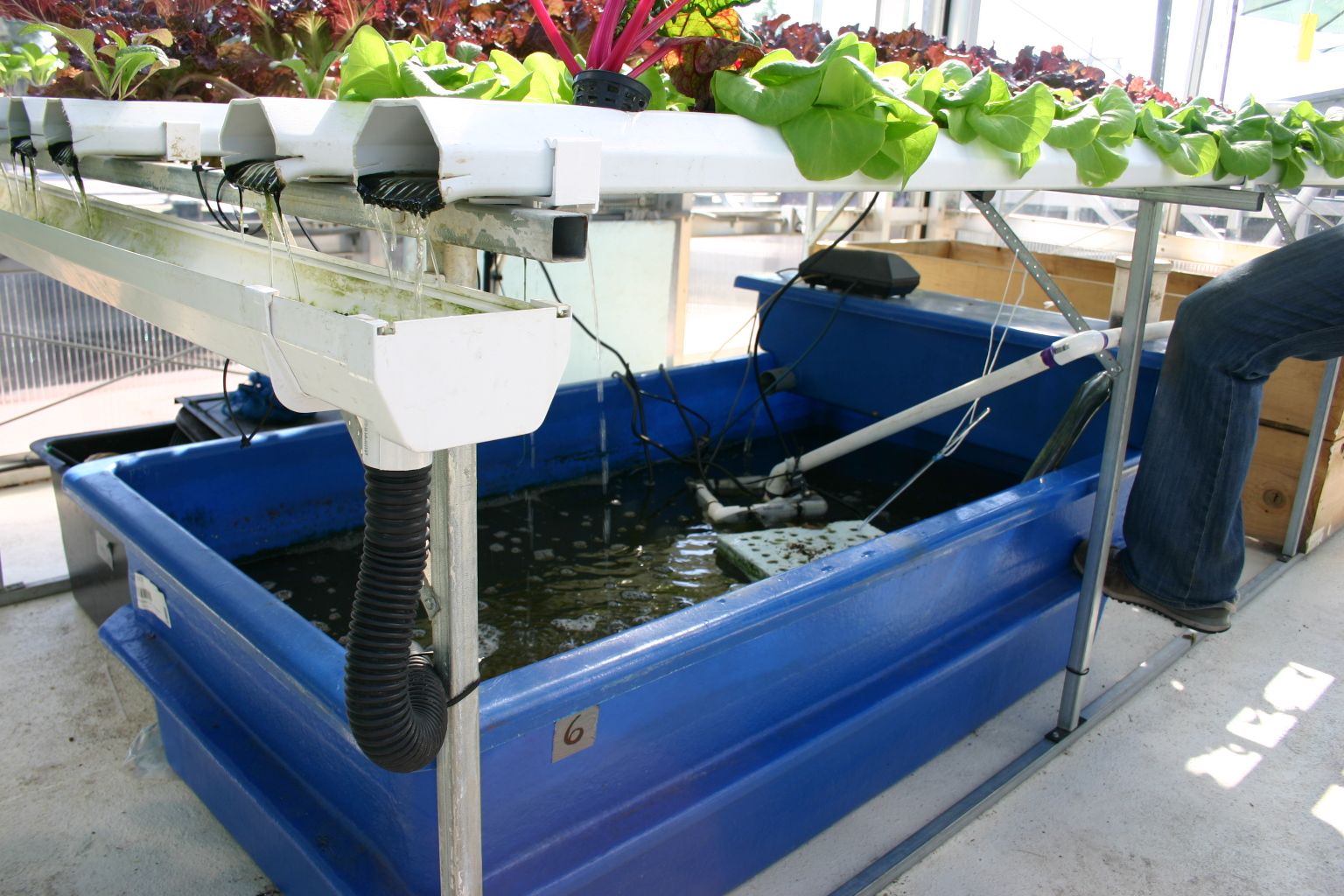
The Phase 1 Nansha workshop is described as an aquaponics intelligent-factory workshop. Warm-water fish and warm-climate plants can, in principle, share a comfortable temperature band more easily than a cold-water salmon would share one with a tropical leaf crop. That is a biological convenience, not an automatic design. Plant species, light, pests, and labour must still be chosen, and the nitrogen from a heavily fed fish tank can outrun a modest plant area. A visitor who likes the idea of a combined crop should ask for a real week’s story — what was harvested, what was fed, and what was dumped — rather than for a poster of a lettuce leaf beside a fish.
Some high-value fishes, including some that prefer lower light or that are easily disturbed, may not be the best companions for a busy greenhouse full of plant workers. Compatibility is a design issue. So is salt, if a nitrite event or a marine species tempts the operator to raise salinity beyond what the plants will bear. Warm-water aquaponics is promising where the two sides are chosen together. It is messy where they are only neighbouring slogans.
A conservative way to choose a first species
A first species for a new warm-water loop should be one the team can already obtain as healthy juveniles or as manageable broodstock, one for which a feed is reliably available, and one for which a market or a demonstration purpose already exists. It should not, as a rule, be the most difficult and most expensive animal on a wish list. Learning the alarm, the filter, and the evening oxygen slump on a hardier fish is not a waste of a workshop. It is often the condition for later attempting a more demanding one.
Public agencies sometimes feel pressure to announce a prestige species from the first day. That pressure has killed projects. A visit to an experimental workshop is a good moment to say this out loud, and to ask how a staged species plan might look in the visitor’s own country, without requiring Nansha to invent a national master plan. Warm-water RAS will reward patience more often than it rewards a press conference.