
Not every fish has to spend its whole life in an indoor tank. Many warm-water farms already know how to use ponds. Pond-relay aquaculture — moving stock between a more intensive indoor or tank stage and an outdoor pond stage — is a way of combining the control of a recirculating workshop with the space and lower capital cost of a pond. Public descriptions of Guangzhou Nansha Zhihui Agricultural Technology include this practice alongside factory RAS operations and park development.
This article explains what pond-relay means, why a farm might use it, what can go wrong at the point of transfer, and how a visitor should look at the practice in Nansha without mistaking a district landscape for the company’s own ponds. Illustrative photographs of outdoor farms and of Nansha’s pond country are captioned honestly. No invented production figures are offered.
Two environments, one crop
A recirculating workshop is good at some things and expensive at others. It can hold temperature, watch water, protect fry or broodstock, and reduce water use. It is costly per cubic metre, and it asks a lot of energy and skill. A pond is good at other things. It offers volume, natural productivity if managed well, and a familiar method for many crews. It is more exposed to weather, birds, and effluent concerns, and it uses more water and land.
Relay farming tries to use each environment for the stage it suits. Fry may be nursed indoors, where survival can be watched and first feeds controlled, then moved to ponds for grow-out. Broodstock may be kept in tanks for spawning and then rested outdoors. In some designs, fish return to a workshop for a final period of cleaner water and easier harvest before sale. The exact pattern depends on the species, the climate, and the market. There is no single correct diagram.
The method is old in spirit. Farmers have long moved animals between nurseries and fattening grounds. What is newer is the combination with a true recirculating loop at the intensive end, and the need to plan biosecurity and water quality at the moment of transfer. A fish that leaves a clear, warm, well-oxygenated tank and enters a pond of different temperature, turbidity, and microbial community is undergoing a shock, even if both places are “fine” on their own terms.
Why farms consider a relay
Capital is the first reason. Indoor tanks large enough to grow every fish to harvest size are expensive. If a workshop can specialise in the delicate early stages, or in broodstock, and if ponds can carry the biomass of grow-out, the building can be smaller. That arithmetic is attractive where land for ponds still exists, as it does in much of southern China and in many Southeast Asian farming districts. It is less available where land is scarce or where ponds are no longer permitted.
Biology is the second reason. Some species, including various warm-water food fishes, tolerate pond life well once they have passed a vulnerable larval or juvenile stage. Nursing them indoors can raise survival at the point where losses are usually highest. Mandarin fish (Siniperca, 鳜鱼), which appear in a 2024 research tender from the Nansha company as a RAS breeding topic, are a high-value warm-water species whose early feeding and domestication are not trivial. A research interest in early stages does not, by itself, define a commercial relay recipe for export, but it shows why indoor and outdoor stages might be thought about together.
Risk is the third reason. A disease in an indoor hall can threaten a concentrated stock. A disease or a flood in a pond can threaten a large area. Spreading stages across two systems does not remove risk, but it can confine some events. It can also create new ones, if transfers are careless. The method is a management choice, not a guarantee.
Water use sits in the middle of these reasons. A recirculating nursery saves water where it is most tightly controlled. Ponds still evaporate and still discharge. A farm that claims to be “recirculating” because it has one indoor hall, while most of its biomass lives in leaking ponds, should be asked for a whole-farm water balance. Honesty about that balance is part of taking the method seriously.
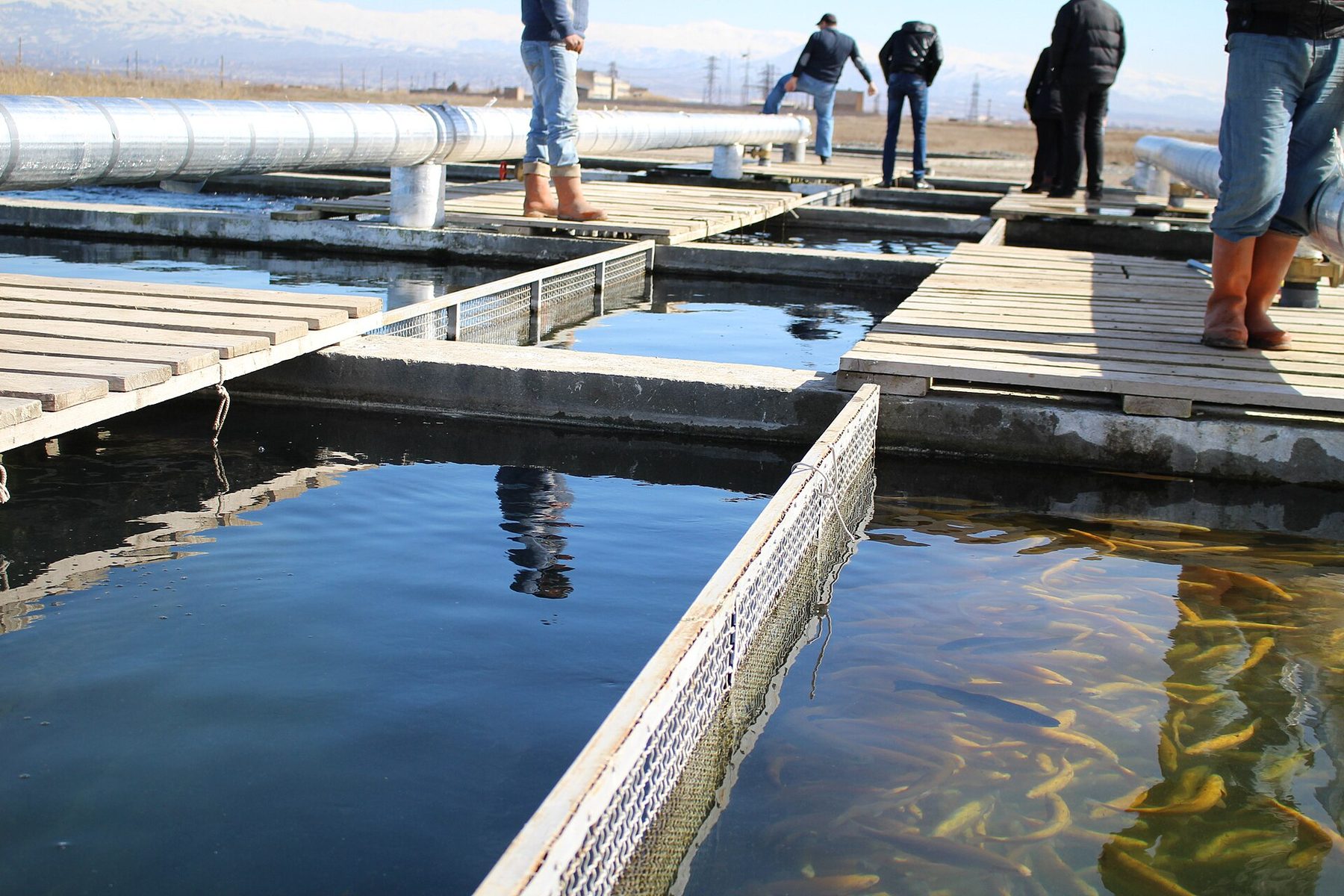
The transfer is the hard part
Fish do not step from one world into another without cost. Temperature should be matched as closely as practical, and changes should be gradual. Dissolved oxygen in the transport tank must be kept high. Density during the move should be planned, not improvised on a hot afternoon. Salt or other conditioners, if used, must be compatible with both the indoor filter and the receiving pond, and with any later market rules.
Biosecurity is sharpest at the gate. Pond water can carry parasites, snails, wild fish, and birds’ gifts. Indoor water can carry pathogens that the pond has not yet seen. A relay farm needs a protocol for what is disinfected, what is tested, and what is never shared — nets, boots, and water included. Microscopy of a sample before a major transfer is a reasonable habit, as is a period of observation after arrival. The companion article on fish health and early detection belongs beside this one.
Predators and theft are outdoor problems that indoor staff sometimes underestimate. Birds, otters, snakes, and human interference are ordinary pond risks in many countries. A relay design that ignores them will lose the advantage it hoped to gain by nursing fish carefully indoors. Fencing, bird wires, night watch, and simple records of unexplained losses are part of the method.
Harvest logistics run in both directions. Moving live fish requires tanks, oxygen, a short road, and a crew that already knows the job. If the pond is far from the workshop, the “relay” becomes a transport business. If it is adjacent, the farm can look simple and still fail on a day when the generator or the truck is missing. A visitor should ask to see the route, not only the two habitats.
Water, effluent, and the whole farm
Ponds discharge when they overflow, when they are drained, and when seepage finds a ditch. A recirculating hall discharges a smaller, more concentrated stream. A farm that uses both must plan both. In Nansha, a 2025 tender describes a tailwater recycling facility, with the company as project owner, aimed at 100 tonnes of aquaculture tailwater and 950 kilograms of solids a day, and at processing solids into fertilizer. That is a park-scale environmental project, not a complete description of every pond in the district. It does show that effluent was being thought about in public documents, which is the right direction.
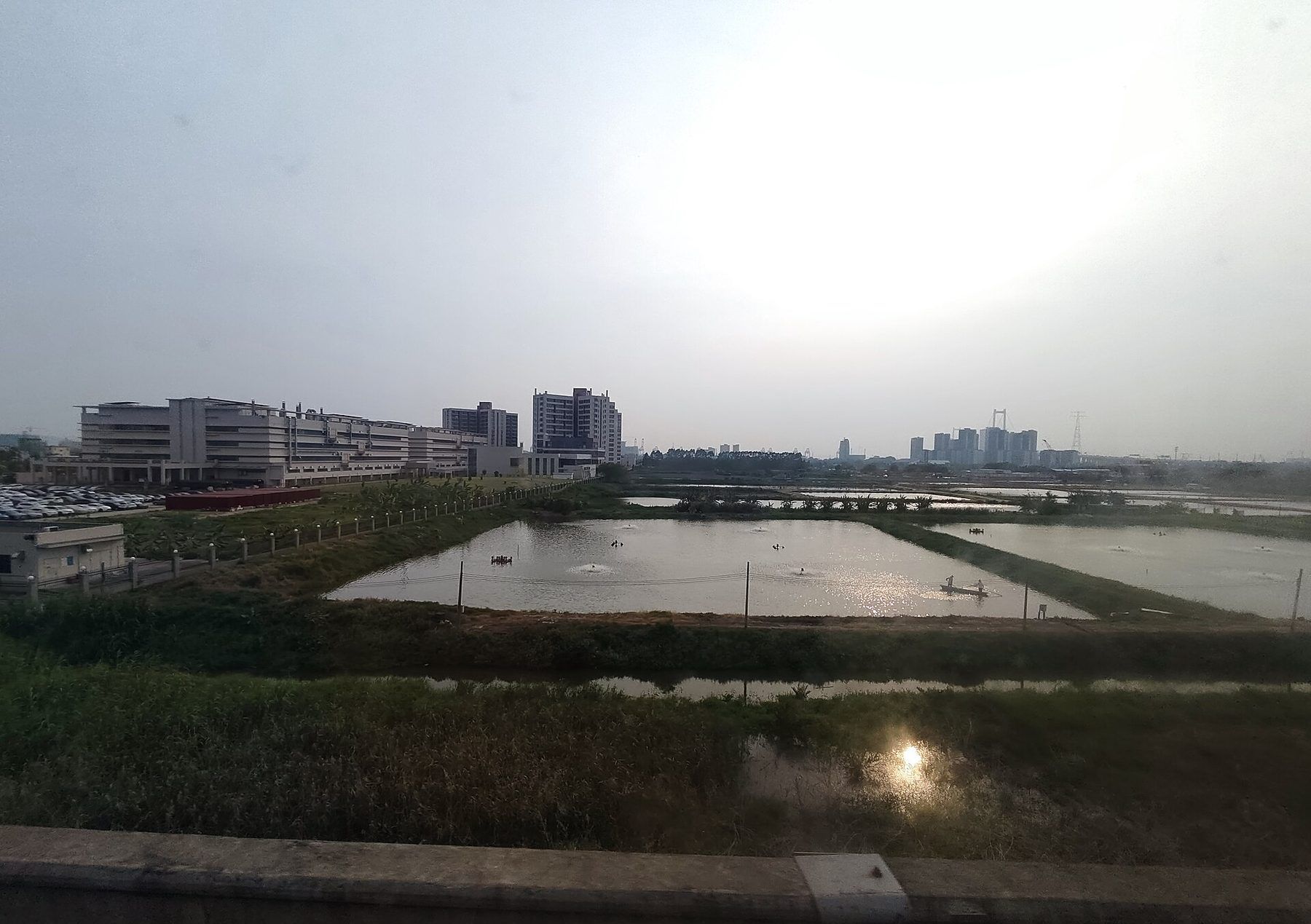
Pond-relay also raises a mapping question for visitors. Nansha District contains extensive fish-pond landscapes. A photograph taken from a road, or a walk through a wetland park, is a picture of the setting, not automatically a picture of the company’s own water. This site uses such images only with captions that say so. Official photographs of the company’s pond-relay ground will be added when they can be supplied with a clear right of use.
What a visitor should look for
A serious conversation about pond-relay will cover the life-history plan: which stages are indoor, which are outdoor, and why. It will cover numbers the farm is willing to share — not invented survival percentages, but the logic of density at transfer, the season, and the labour required. It will cover biosecurity at the boundary, transport, and what happens when the pond’s weather turns against the plan. It will cover effluent from both stages.
Gulf buyers may find that land and evaporation make large ponds less attractive than they are in a wet subtropical delta. For them, the indoor stage may be the main story, and the “relay” may shrink to a quarantine or a research pond. Southeast Asian buyers, in places where ponds are already the backbone of production, may be more interested in how a recirculating nursery could raise the quality of what goes into those ponds. Both conversations are legitimate. Neither requires a claim that Nansha’s pattern can be copied hectare for hectare.
Pond-relay aquaculture is a way of letting tanks and ponds do the work each does best, at the cost of a more complicated boundary between them. Public descriptions of the Nansha company include this practice. A visit is the right place to see how the stages are organised locally, and to ask the unglamorous questions about transfer, health, and discharge. This article has tried to name those questions in advance, so that the walk along the dyke, when it happens, is more precise.
Matching the stage to the animal
A relay plan begins with the life history of the species, not with the building. Larvae and early juveniles are usually the most expensive to lose and the most sensitive to water-quality swings, so they often justify indoor control even when later stages will go outside. On-growing fish may use space and natural food in a pond in a way that would be wasteful to imitate with heated tanks. Broodstock may need a quiet, inspectable tank in the weeks around spawning, and a cheaper holding pond at other times. Each of those sentences must be checked against the species in question. A plan written for tilapia will not automatically serve a mandarin fish, a grouper, or a shrimp, and this site does not invent a universal recipe.
Season is part of the match. In a subtropical climate, a pond may be hospitable for only part of the year, or it may be hospitable all year but with very different growth and disease pressure in the wet summer and the dry cooler months. Transfers should be timed with that calendar, and with the market calendar, not only with the day a tank happens to be full. A workshop that cannot say when it prefers to move fish is still thinking in diagrams rather than in seasons.
Size at transfer should be a written rule, even if it is later adjusted. Fish that are too small may be lost to weather or to predators. Fish that are held too long indoors occupy expensive space and may become poorly adapted to pond life. Staff should know the target weight or length, the acceptable range, and what happens when a cohort misses the window. Those are ordinary production questions. They are also the questions that reveal whether a relay is actually practiced or only described.
Records that make a relay intelligible
Because the crop moves, the record must move with it. A tank number, a pond number, a date, a count or a sample weight, a water-quality note at departure and at arrival, and a note of any losses in transit — these are the minimum. Without them, later mortality in the pond cannot be traced, and the indoor stage cannot be improved. A management platform can hold these events if someone enters them. A paper book can hold them if it is actually filled in. The medium matters less than the habit.
Health records should travel too. A slide taken before transfer, and a note of any treatment already given, will save argument later if the pond performs badly. Conversely, a pond problem should be reported back to the workshop, so that the next indoor cohort can be prepared differently. Relay farming fails quietly when the two crews stop talking to each other.
Water-scarce buyers should also record evaporation, seepage, and any emergency pumping between pond and well, because those flows can dwarf the workshop’s recirculating savings. A whole-farm notebook is the only way to keep the word “recirculating” honest when ponds are in the picture. Southeast Asian operators who already keep pond books may find this natural. Operators new to ponds may need to learn it as carefully as they learn the indoor filter.
Limits that should be said out loud
Pond-relay will not fit every site. A Gulf project that has no permitted pond area, or whose evaporation and salinity make earthen ponds unattractive, may conclude that a fully indoor design, or a design with only a small quarantine pond, is more rational. A project in a floodplain may conclude the opposite, and then discover that flood risk has not been priced. Neither conclusion can be read off a Nansha visit alone, but a visit can show what the combination looks like when both kinds of water are at hand.
The public record used for this site describes pond-relay as part of the company’s publicly stated business, alongside factory RAS operations and park development. It does not provide an audited map of every pond, a survival table, or a commercial offer of a relay package for export. Official photographs of the company’s own relay grounds remain to be added. Until they are, illustrative and district-setting photographs, clearly captioned, are used so that readers can see the kind of landscape in which such a conversation takes place.
If this method is part of the reason for a visit, come with a life-history sketch of your own species, a candid account of the land and water you actually have, and a willingness to talk about the transfer as the centre of the design. The tanks and the ponds are easy to admire separately. The work is in the hand-off between them.